10.3 Pyruvate Oxidation and the Citric Acid Cycle
Learning Objectives
By the end of this section, you will be able to do the following:
- Explain how a circular pathway, such as the citric acid cycle, fundamentally differs from a linear biochemical pathway, such as glycolysis.
- Describe how pyruvate, the product of glycolysis, is prepared for entry into the citric acid cycle.
If oxygen is available, aerobic respiration will go forward. In eukaryotic cells, the pyruvate molecules produced at the end of glycolysis are transported into the mitochondria, which are the sites of cellular respiration. There, pyruvate is transformed into an acetyl group that will be picked up and activated by a carrier compound called coenzyme A (CoA). The resulting compound is called acetyl CoA. CoA is derived from vitamin B5, pantothenic acid. Acetyl CoA can be used in a variety of ways by the cell, but its major function is to deliver the acetyl group derived from pyruvate to the next stage of the pathway in glucose catabolism.
Breakdown of Pyruvate
In order for pyruvate, the product of glycolysis, to enter the next pathway, it must undergo several changes. The conversion is a three-step process (Figure 10.2.1), which takes place in transition between the cytoplasm where reactant, pyruvate, is produced through both mitochondrial membranes to the mitochondrial matrix where the product, Acetyl-coA is produced.
Step 1. A carboxyl group is removed from pyruvate, releasing a molecule of carbon dioxide into the surrounding medium. We should note that this is the first of the six carbons from the original glucose molecule to be removed. (This step proceeds twice because there are two pyruvate molecules produced at the end of glycolysis for every molecule of glucose metabolized anaerobically; thus, two of the six carbons will have been removed at the end of both steps.)
Step 2. The remaining carbons are oxidized to produce an acetyl group bound to the enzyme pyruvate dehydrogenase, and the electrons are picked up by NAD+, forming NADH. The high-energy electrons from NADH will be used later to generate ATP.
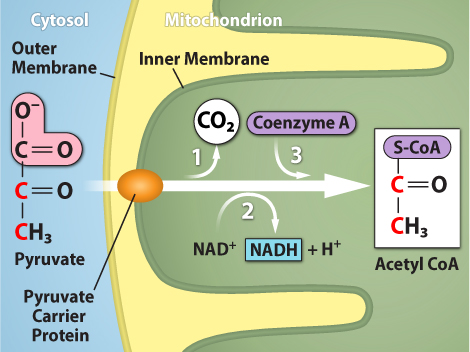
Step 3. The enzyme-bound acetyl group is transferred to CoA, producing a molecule of acetyl CoA.
Note that during the second stage of glucose metabolism, whenever a carbon atom is removed, it is bound to two oxygen atoms, producing carbon dioxide, one of the major end products of cellular respiration.
Acetyl CoA to CO2
In the presence of oxygen, acetyl CoA delivers its acetyl (2C) group to a four-carbon molecule, oxaloacetate, to form citrate, a six-carbon molecule with three carboxyl groups; this pathway will harvest the remainder of the extractable energy from what began as a glucose molecule and release the remaining four CO2 molecules. This single pathway is called by different names: the citric acid cycle (for the first intermediate formed—citric acid, or citrate—when acetate joins to the oxaloacetate), the TCA cycle (because citric acid or citrate and isocitrate are tricarboxylic acids), and the Krebs cycle, after Hans Krebs, who first identified the steps in the pathway in the 1930s in pigeon flight muscles.
Video 10.1.1. Pyruvate Dehydrogenase | HHMI BioInteractive Video by biointeractive
Citric Acid Cycle
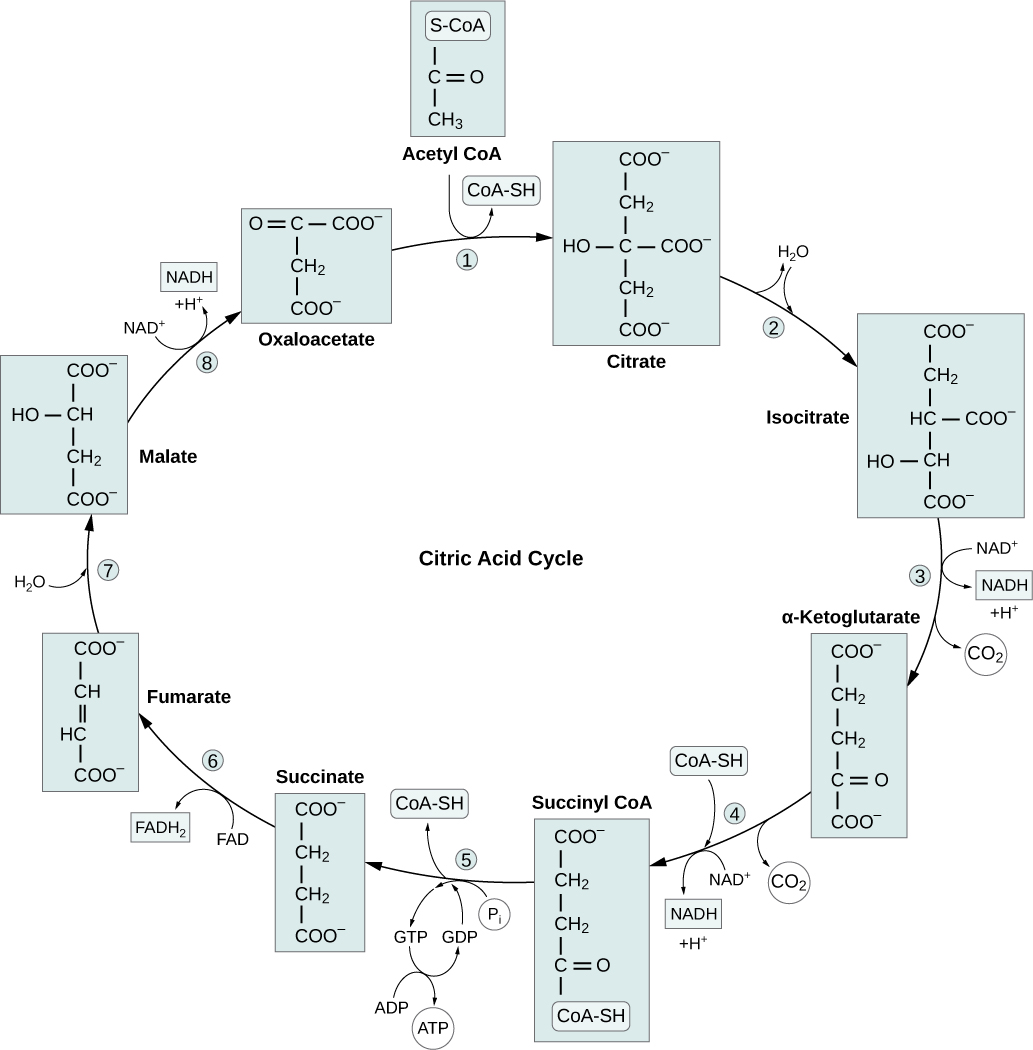
Like the conversion of pyruvate to acetyl CoA, the citric acid cycle takes place in the matrix of mitochondria. Almost all of the enzymes of the citric acid cycle are soluble, with the single exception of the enzyme succinate dehydrogenase, which is embedded in the inner membrane of the mitochondrion. Unlike glycolysis, the citric acid cycle is a closed loop: the last part of the pathway regenerates the compound used in the first step. The eight steps of the cycle are a series of redox, dehydration, hydration, and decarboxylation reactions that produce two carbon dioxide molecules (this accounts for the remaining carbons that came in with glucose), one GTP/ATP, and the reduced carriers NADH and FADH2 (Figure 10.2.2). This is considered an aerobic pathway because the NADH and FADH2 produced must transfer their electrons to the next pathway in the system, which will use oxygen. If this transfer does not occur, the oxidation steps of the citric acid cycle also do not occur. Note that the citric acid cycle produces very little ATP directly and does not directly consume oxygen.
Products of the Citric Acid Cycle
Two carbon atoms come into the citric acid cycle from each acetyl group, representing four out of the six carbons of one glucose molecule. Two carbon dioxide molecules are released on each turn of the cycle; however, these do not necessarily contain the most recently added carbon atoms. The two acetyl carbon atoms will eventually be released on later turns of the cycle; thus, all six carbon atoms from the original glucose molecule are eventually incorporated into carbon dioxide. Each turn of the cycle forms three NADH molecules and one FADH2 molecule. These carriers will connect with the last portion of aerobic respiration, the electron transport chain, to produce ATP molecules. One GTP or ATP is also made in each cycle. Several of the intermediate compounds in the citric acid cycle can be used in synthesizing nonessential amino acids; therefore, the cycle is both catabolic and anabolic.
Video 10.2.2. Citric Acid Cycle | HHMI BioInteractive Video by biointeractive
Connections of Other Nutrients to Glucose Metabolism
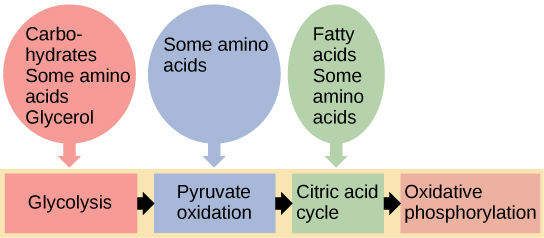
You have learned about the catabolism of glucose, which provides energy to living cells. But living things consume organic compounds other than glucose for food. How does a turkey sandwich end up as ATP in your cells? This happens because all of the catabolic pathways for carbohydrates, proteins, and lipids eventually connect into glycolysis and the citric acid cycle pathways (see Figure 10.2.3). Metabolic pathways should be thought of as porous and interconnecting—that is, substances enter from other pathways, and intermediates leave for other pathways. These pathways are not closed systems! Many of the substrates, intermediates, and products in a particular pathway are reactants in other pathways. For example, intermediates from the citric acid cycle can be used to build up amino acids or acetyl-coA can be used to produce lipids. Cellular respiration is a node for all metabolic processes in cells both catabolic and anabolic.
Practice Questions
Glossary
acetyl-coA
mitochondrial matrix
intermembrane space
Figure Descriptions
Figure 10.2.1. This diagram illustrates the conversion of pyruvate into acetyl CoA as it enters the mitochondrial matrix from the cytosol. On the left, pyruvate (C₃H₄O₃) is shown in the cytosol near the outer mitochondrial membrane. It moves through a pyruvate carrier protein into the mitochondrial matrix, crossing the outer and inner membranes. Once inside, a three-step reaction occurs: 1) carbon dioxide (CO₂) is released; 2) NAD⁺ is reduced to NADH and H⁺; and 3) coenzyme A combines with the remaining acetyl group to form acetyl CoA (C₂H₃O-CoA), which enters the citric acid cycle. The diagram uses arrows and labels to show the sequence of reactions, with chemical formulas and color-coded elements such as NADH and Coenzyme A. The image highlights that this is a preparatory step linking glycolysis to the citric acid cycle. [Return to Figure 10.2.1]
Figure 10.2.2. This image shows the citric acid cycle (also known as the Krebs cycle or TCA cycle) as a circular series of chemical reactions that begins with the combination of acetyl CoA and oxaloacetate to form citrate. The diagram proceeds clockwise through eight key intermediates, each enclosed in a blue box with its full chemical structure. Starting at the top, acetyl CoA (a two-carbon molecule) combines with oxaloacetate (a four-carbon molecule) to form citrate (six carbons). The cycle continues with citrate being rearranged into isocitrate, then oxidized to α-ketoglutarate, releasing a molecule of CO₂ and reducing NAD⁺ to NADH. Another oxidation step converts α-ketoglutarate into succinyl CoA, releasing another CO₂ and producing NADH. Succinyl CoA is then converted into succinate, generating ATP (or GTP) via substrate-level phosphorylation. Succinate is oxidized to fumarate, reducing FAD to FADH₂, followed by the conversion of fumarate to malate, and finally malate to oxaloacetate, with another NADH produced. Arrows indicate the direction of reactions, and enzyme cofactors (NAD⁺/NADH, FAD/FADH₂, GDP/GTP, ADP/ATP, and water) are labeled at each step. The diagram emphasizes that the cycle regenerates oxaloacetate, allowing it to continue as long as reactants are available. [Return to Figure 10.2.2]
Figure 10.2.3. The image is a diagram depicting the stages of cellular respiration with labeled components. It consists of four connected rectangular boxes in a horizontal sequence, each labeled with a stage of cellular respiration. The first box, colored red, is labeled “Glycolysis.” An arrow connects it to a blue box labeled “Pyruvate oxidation.” This is followed by a green box labeled “Citric acid cycle,” which links to an orange box labeled “Oxidative phosphorylation.” Above each box, there are colored circles that describe the inputs for each stage. The red circle above glycolysis lists “Carbohydrates, Some amino acids, Glycerol.” The blue circle above pyruvate oxidation mentions “Some amino acids.” The green circle above the citric acid cycle lists “Fatty acids, Some amino acids.” [Return to Figure 10.2.3]
Licenses and Attributions
“10.3 Pyruvate Oxidation and the Citric Acid Cycle” is adapted from “7.3 Oxidation of Pyruvate and the Citric Acid Cycle” by Mary Ann Clark, Matthew Douglas, and Jung Choi for OpenStax Biology 2e under CC-BY 4.0. “10.3 Pyruvate Oxidation and the Citric Acid Cycle” is licensed under CC-BY-NC 4.0.
Media Attributions
- 189892a2e492714e5e91daa0ba12912a21ffd287
- a84c5164820430e4fbb277e533da26ccdbba5490
- Differential inputs into cellular respiration © OpenStax Biology 2e is licensed under a CC BY-SA (Attribution ShareAlike) license